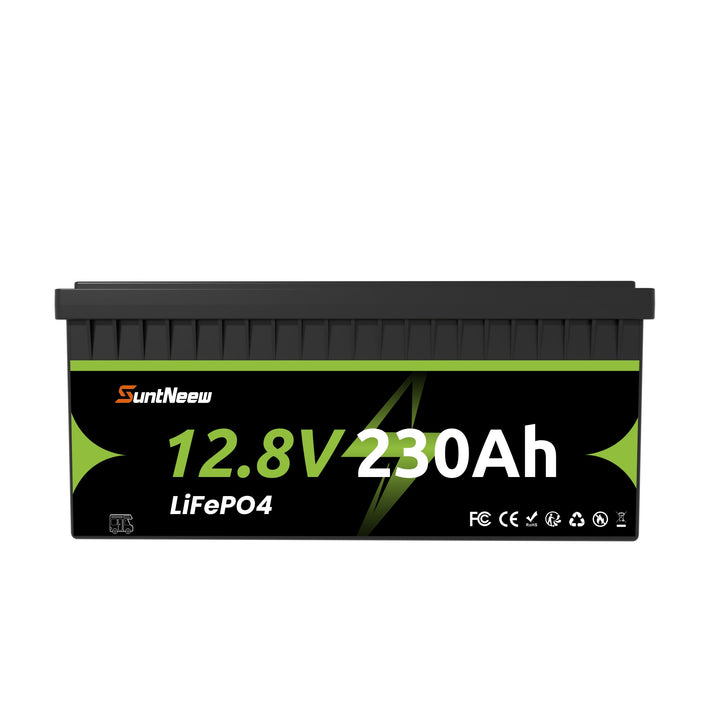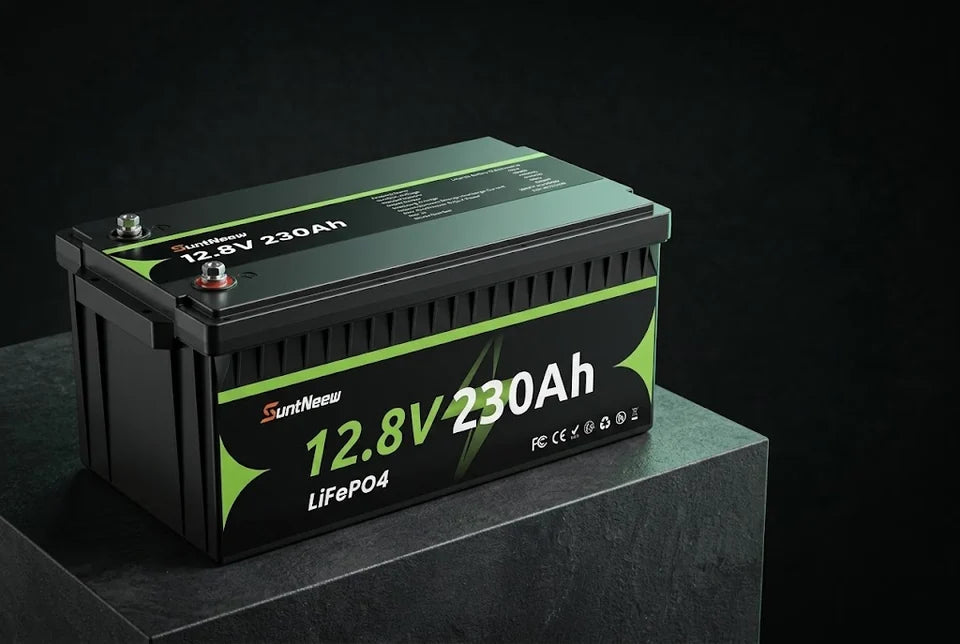
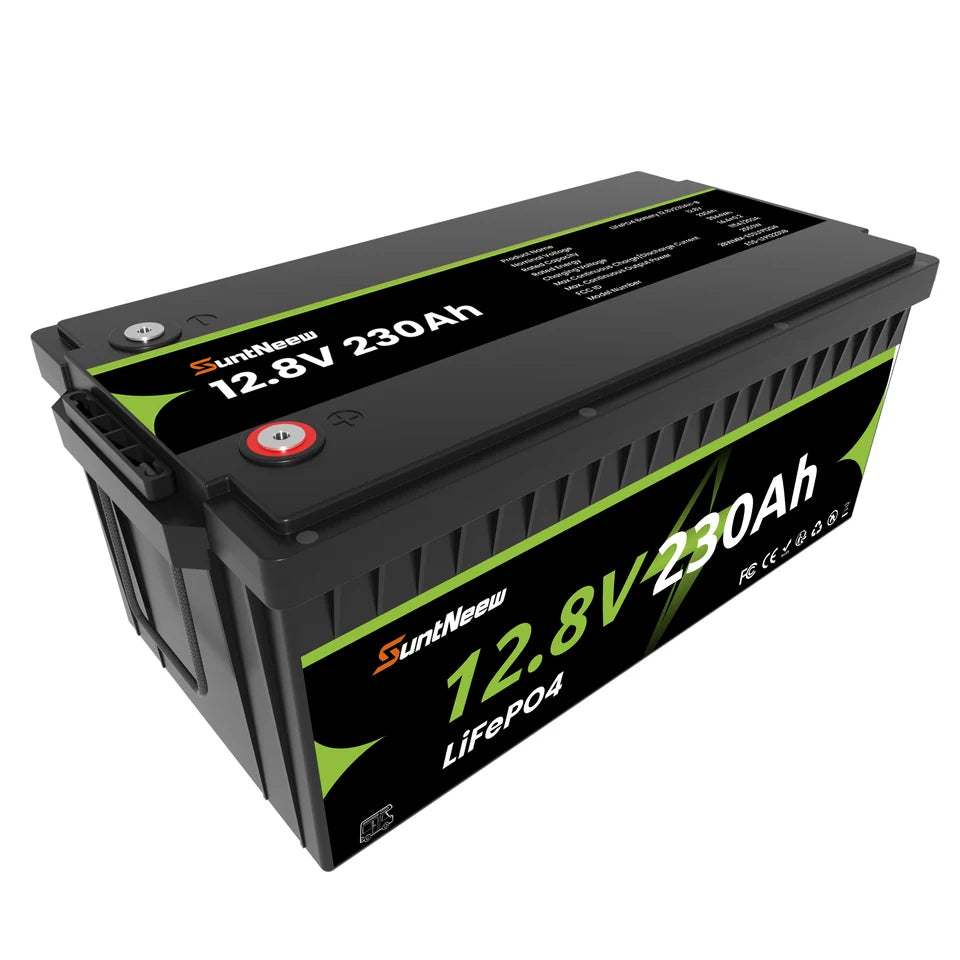
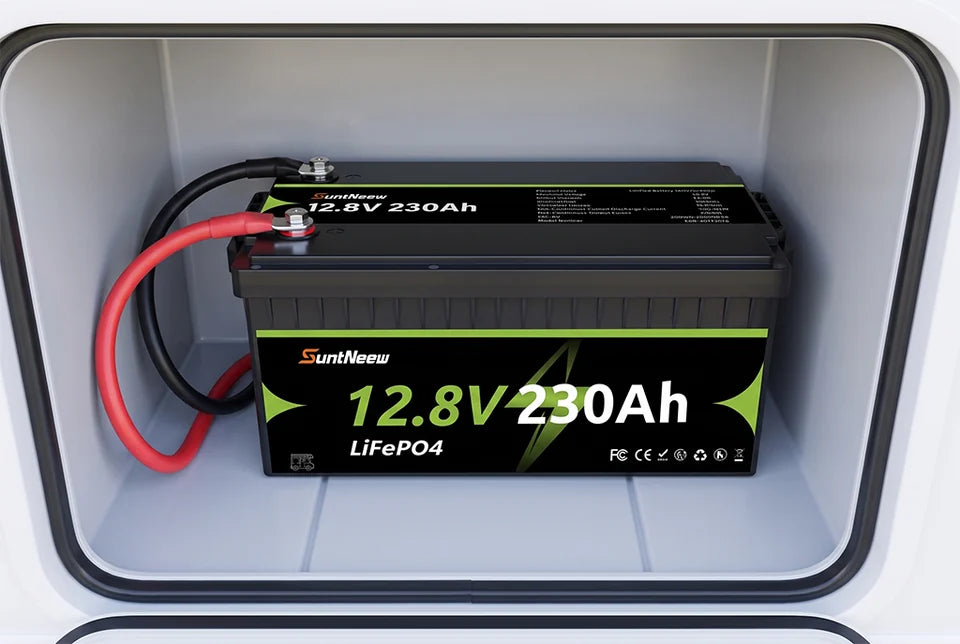
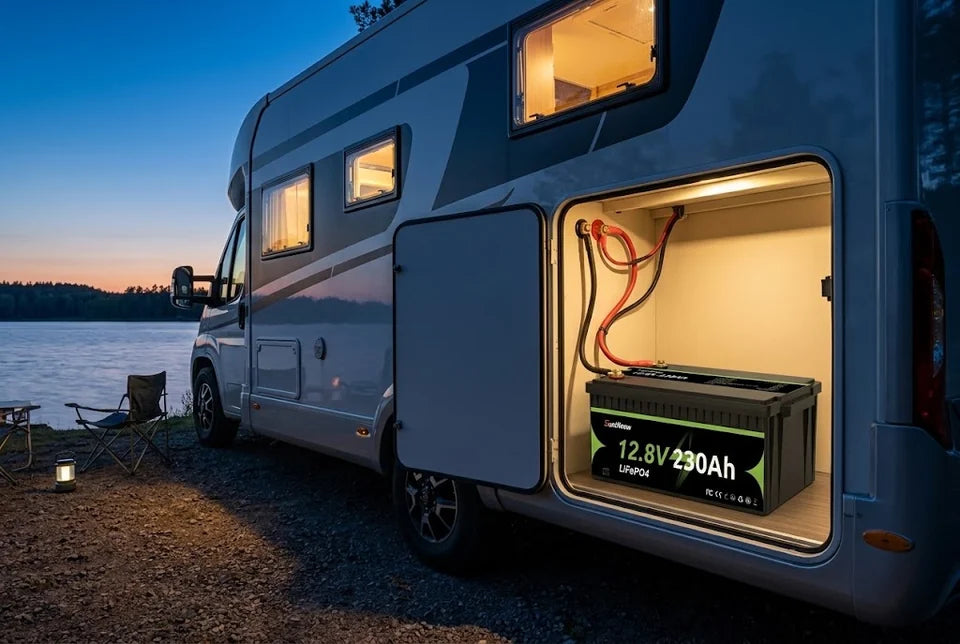
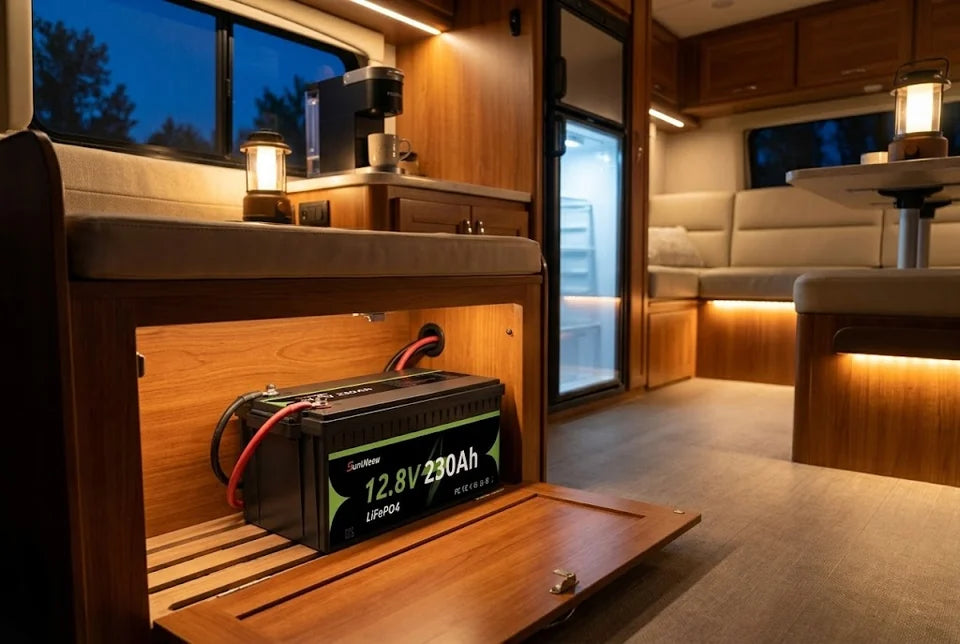
OUTPUT WITHOUT UNUSED BULK
Choose 230Ah for the load.
Get 2,560W of continuous output from a 20.6kg battery. It is the stronger choice for higher inverter demand when your route already includes regular solar, alternator or shore-power charging.
Impuestos excluidos. Los impuestos y gastos de envío se calculan en la pantalla de pago
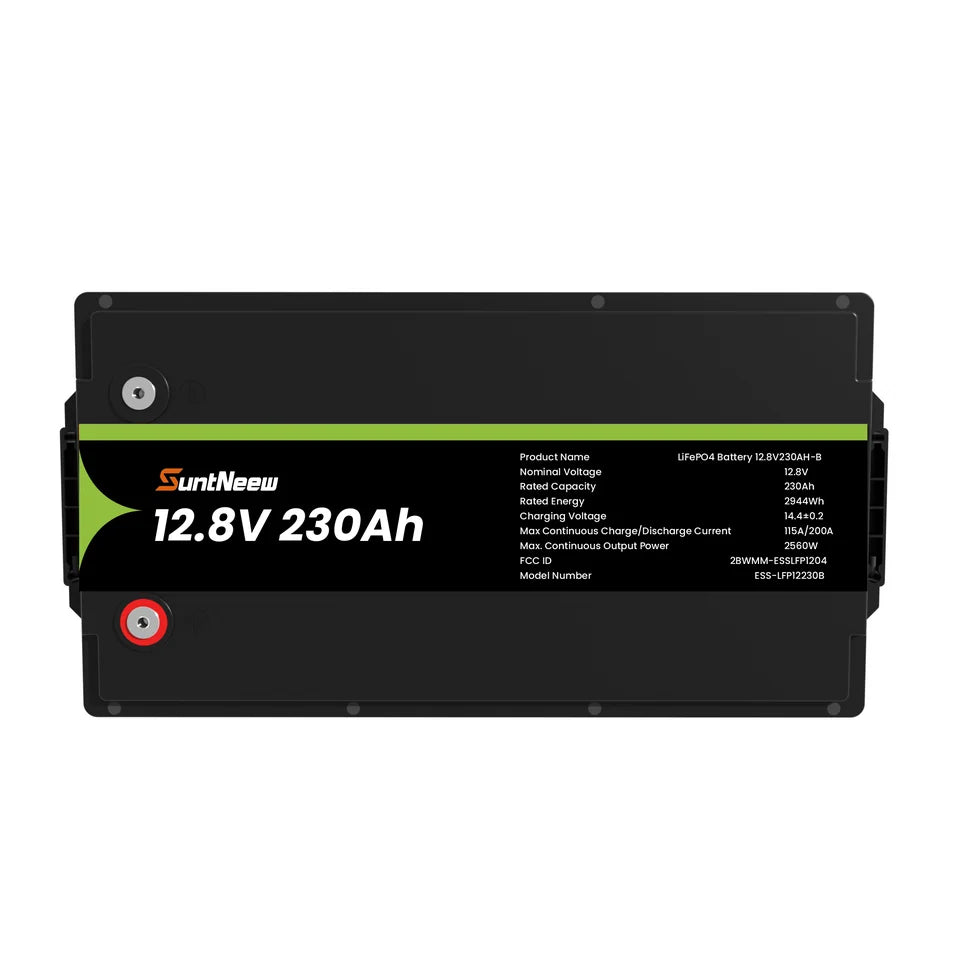
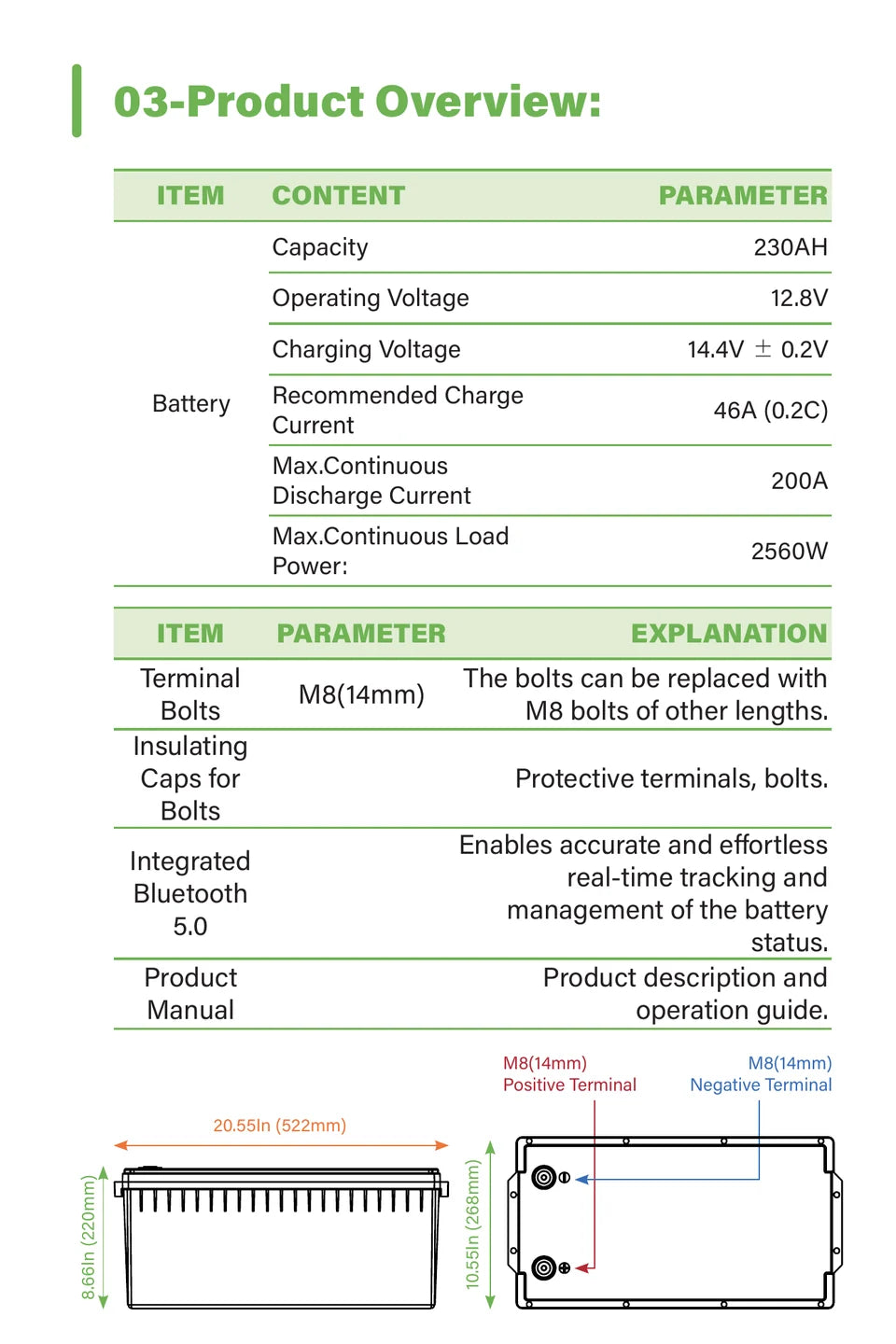
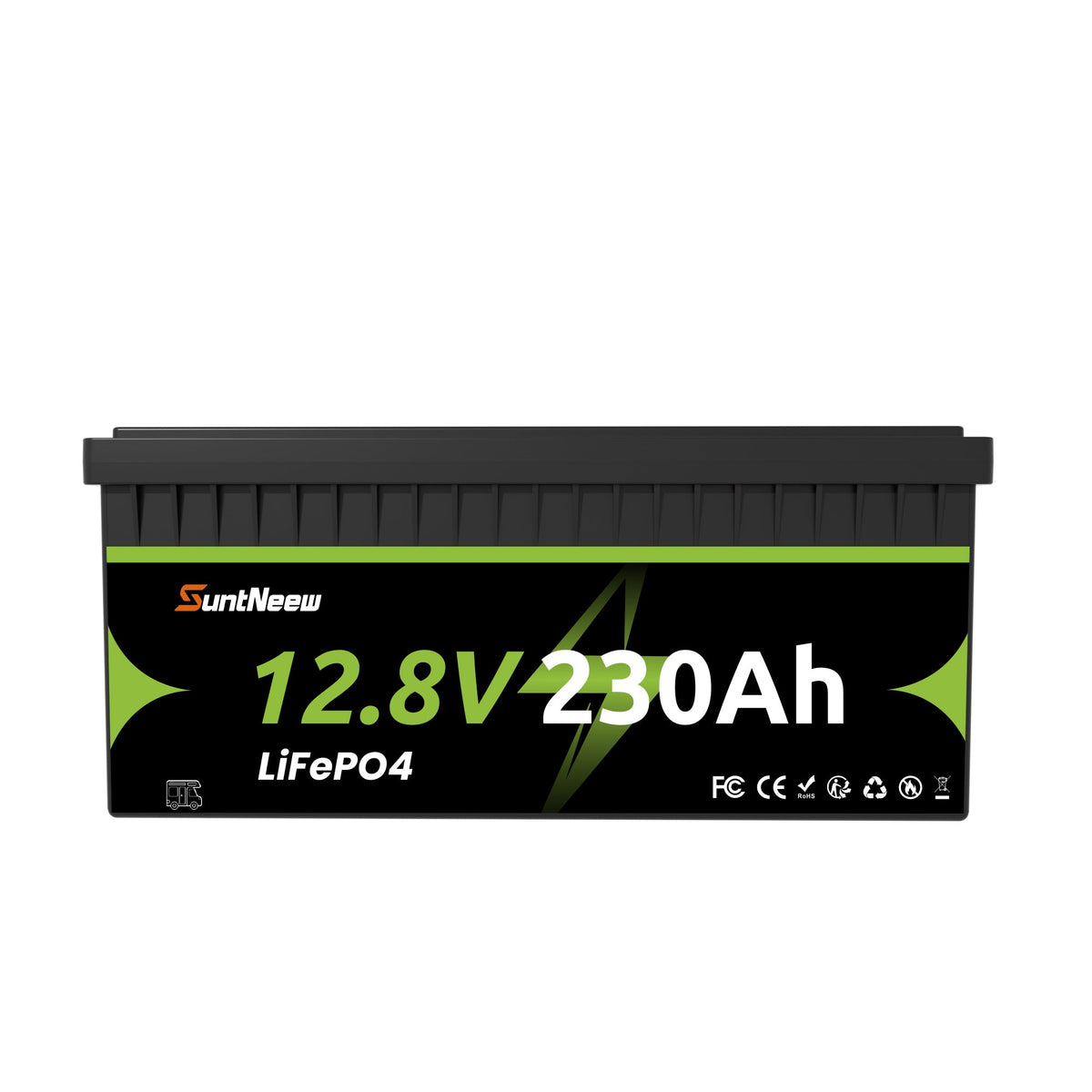
Choose the 12.8V 230Ah RV battery when output, weight and value matter more than maximum time between charges: 2,944Wh rated energy, 2,560W / 200A continuous output, 20.6kg weight and Bluetooth 5.0 monitoring.
Multi-pack quantity
Choose 1, 2, 5 or 10 units, or use a custom quantity.

230AH OR 314AH?
The enclosure size is the same. Pick by priority, then use the Power Calculator to check the appliances you run.
230AH FEATURES
Choose 230Ah for the load: it delivers 2,560W continuous output, weighs 5.4kg less than 314Ah and costs less, while keeping 2,944Wh onboard in the same enclosure footprint.
OUTPUT WITHOUT UNUSED BULK
Get 2,560W of continuous output from a 20.6kg battery. It is the stronger choice for higher inverter demand when your route already includes regular solar, alternator or shore-power charging.
TRAVEL, RECHARGE, MOVE AGAIN
If you replenish from driving, solar or shore power most days, 230Ah keeps 2,944Wh onboard while saving 5.4kg versus the same-size 314Ah model.
BUILT FOR THE BUSY MOMENTS
A 2,560W continuous-output ceiling gives a correctly sized inverter system more room for kitchen bursts, cooling and the background loads already running.
THE OUTPUT-FIRST 12V CHOICE
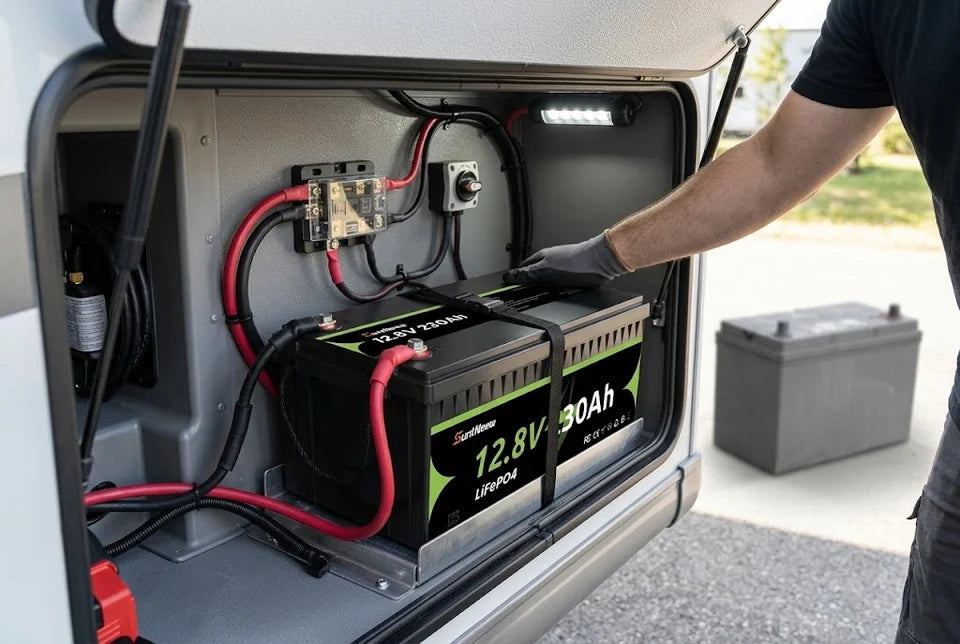
Choose 230Ah when the electrical design needs the stronger continuous-current rating. Size the inverter, conductors, fuse, disconnect and terminals to the complete system limit.
LESS WEIGHT IN THE SAME BAY
Both large-capacity models share the stated 522 × 268 × 220mm enclosure. Choose 230Ah when structure, payload and service handling matter more than the extra reserve.
DESIGN AROUND THE REAL LOAD
230Ah is the practical middle ground when daily energy stays within 2,944Wh but simultaneous demand needs up to 2,560W. Use the Power Planner to test your own devices.
BLUETOOTH 5.0 MONITORING
Check supported app readings for state of charge, voltage, current and battery temperature before a demanding appliance or the next travel leg.
COLD-WEATHER PROTECTION
Low-temperature charging protection pauses charging below the documented limit and resumes when conditions recover, so winter installation planning is easier.
MADE FOR REGULAR REPLENISHMENT
230Ah makes the most sense when charging is already part of the route. Pair it with LiFePO4-compatible CC/CV equipment and coordinate every source within the documented limits.
DOCUMENTS BEFORE INSTALLATION
Use the English manual as the installation source of truth, then review the shared FCC SDoC, CE-EMC and RV-series RoHS public copies in the Documents section.
SCALE OUTPUT AND ENERGY TOGETHER
Series and parallel layouts give larger RV builds a path to more voltage, output or reserve when identical batteries, balanced wiring, fusing and disconnects are planned as one system.
Verified product data
The key capacity, charging, protection and installation values are transcribed from the current English product manual. Use the manual for the full operating sequence and safety limits.
Installation planning
Product documentation
IP65 is shown as the unified RV-line enclosure specification. The compliance cards identify the exact shared or model-matched scope; public copies are added only after redaction review.
230Ah planning
The rated energy is 2,944Wh, calculated from the documented 12.8V and 230Ah ratings. Usable energy depends on system settings, load and operating conditions.
200A is the documented maximum continuous-discharge rating. The inverter, conductors, fuses, terminals and temperature conditions must also support the planned load.
The manual lists 46A as the recommended charge current and 115A as the maximum continuous charge current, using a 14.4V +/- 0.2V CC/CV profile. Coordinate all charging sources within those limits.
IP65 indicates a dust-tight enclosure with protection against water jets. It is not an immersion rating; keep the battery location, terminals and cable routing protected and follow the installation manual.
Choose 230Ah when 2,944Wh covers your time between charges and you want 2,560W continuous output, 5.4kg less weight and the lower current single-unit price. Choose 314Ah when 2,010W covers the load and the priority is 1,075.2Wh more reserve in the same 522 × 268 × 220mm enclosure. Test your devices in the Power Planner.
The current English product manual is available in Documents on this page. Review it together with the charger, inverter and RV manufacturer instructions before installation.