

What Size Jump Starter Do You Need? Matching Peak Current to Engine Displacement
- Category: Buying Guides
- Topic: Automotive Starting Systems, Engine Sizing & Cranking Current
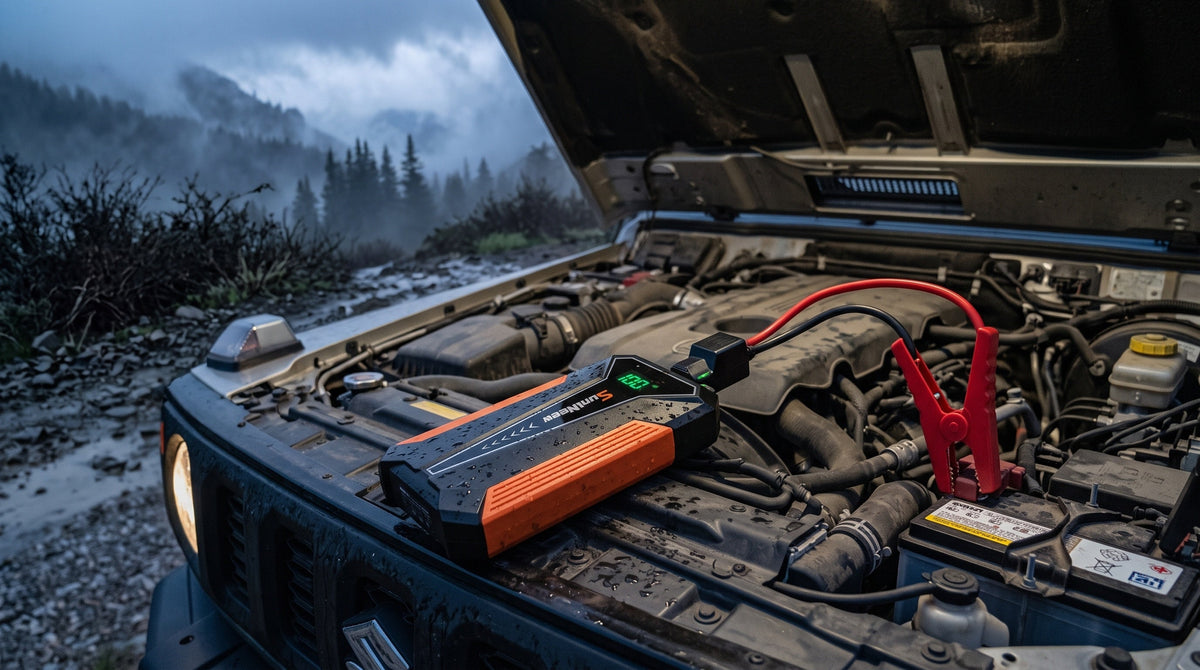
- Featured Model: SuntNeew A20 1500A Portable Lithium Jump Starter (Model: CY-A20)
- Reading Time: 11 minutes
- Author: SuntNeew Editorial
- Status: Ready to Publish
- Internal Mapping: JRN-G03

The Core Dilemma: Decoding Marketing Claims vs. Real Cranking Power
Few experiences in vehicle ownership match the abrupt sinking feeling of turning the ignition key and hearing nothing more than a dull, rapid metallic click—or worse, total silence. Whether caused by leaving headlights on at a remote trailhead, an interior dome light left switched on overnight, or a sudden winter cold snap that crippled an aging lead-acid battery, a dead starting battery halts your plans instantly.
When shopping for an emergency jump starter to keep in a glove box or center console, consumers are immediately inundated with hyperbolic marketing claims. Retail shelves and online marketplaces are flooded with compact devices boasting "3,000 Amps", "4,000 Amps", or even "5,000 Amps Peak Current" on units no larger than an average paperback book.
These exaggerated numbers create severe confusion:
- Does a standard 2.0-liter four-cylinder sedan require 2,000 Amps?
- Will an oversized jump starter "fry" or damage a small vehicle's delicate engine control unit (ECU)?
- Why do so many compact jump starters fail completely when attempting to start a 5.7-liter V8 pickup on a sub-zero winter morning?
The reality is that cranking an internal combustion engine is governed by strict mechanical and electrical physics. Peak marketing numbers mean virtually nothing if a device cannot sustain sufficient cranking voltage under real starter motor load.
In this guide, we break down the engineering physics of engine starting, analyze the critical differences between gasoline and diesel engines, evaluate the impact of cold-weather oil viscosity, and explain exactly why the SuntNeew A20 (1500A Peak Current / Model: CY-A20) is precisely calibrated to start gasoline engines up to 6.0 Liters and diesel engines up to 3.0 Liters.
The Physics of Cranking: What Happens When You Turn the Key?
To understand how to size a jump starter, you must examine the extreme electrical event that occurs under your vehicle's hood during the first three seconds of ignition:
```
┌────────────────────────────────────────────────────────────────────────┐
│ THE THREE PHASES OF ENGINE STARTING ELECTRICAL DEMAND │
├────────────────────────────────────────────────────────────────────────┤
│ 1. Inrush / Breakaway Current (0 to 50 milliseconds): │
│ ├── Starter pinion meshes with flywheel ring gear. │
│ ├── Motor is stationary (zero back-EMF); acts as a pure short circuit│
│ └── Current spikes to massive peak: 400A - 800A instantaneous. │
├────────────────────────────────────────────────────────────────────────┤
│ 2. Sustained Cranking Current (0.1 to 2.5 seconds): │
│ ├── Engine rotates against compression strokes and friction. │
│ ├── Current stabilizes: 150A - 300A continuous draw. │
│ └── Voltage must remain above 9.5V to keep fuel injectors & ECU alive│
├────────────────────────────────────────────────────────────────────────┤
│ 3. Disengagement & Engine Run (> 2.5 seconds): │
│ ├── Combustion begins; engine speed exceeds starter speed. │
│ ├── One-way overrunning clutch disengages starter pinion. │
│ └── Electrical load transfers immediately to the vehicle alternator.│
└────────────────────────────────────────────────────────────────────────┘
```
When you turn the key, your vehicle’s starter solenoid slams the starter motor’s drive pinion into the flywheel ring gear. At that initial instant, the starter motor is completely stationary. Because an electric motor produces zero Counter-Electromotive Force (back-EMF) when stopped, it acts almost like a dead short circuit across the battery terminals.
This initial pulse—known as Inrush Current or Breakaway Torque Current—spikes to hundreds of Amperes in a fraction of a second to overcome the mechanical inertia of pistons, connecting rods, the crankshaft, and the viscous drag of cold engine oil.
Once the engine begins spinning at cranking speed (typically 150 to 250 RPM), current drops to the Sustained Cranking Current until spark and fuel injection achieve autonomous combustion.
For a jump starter to succeed, it must do two things simultaneously:
- Supply sufficient inrush current to break the engine free.
- Maintain terminal voltage above 9.5 Volts throughout the crank. If voltage sags below 9.0V, the vehicle's computer (ECU) resets, fuel injection shuts off, and the engine will spin endlessly without starting.
Gasoline vs. Diesel: Why Compression Changes the Math
The single most important variable in sizing a jump starter is whether the vehicle burns gasoline or diesel.
Two engines with the exact same 3.0-liter displacement require completely different amounts of electrical power to crank, because their internal combustion mechanics are fundamentally different.
```
┌────────────────────────────────────────────────────────────────────────┐
│ GASOLINE VS. DIESEL CRANKING REQUIREMENTS │
├────────────────────────────────────────────────────────────────────────┤
│ Parameter │ Gasoline Engine (e.g., 3.0L)│ Diesel Engine (e.g., 3.0L) │
├───────────────────────────┼─────────────────────────────┼────────────────────────────┤
│ Compression Ratio │ 8.5:1 to 11.5:1 │ 16.0:1 to 22.0:1 │
│ Ignition Method │ Electric Spark Plug │ Heat of High Compression │
│ Inrush Cranking Current │ 200A - 350A │ 450A - 700A │
│ Pre-Crank Parasitic Load │ None (< 5A) │ Glow Plugs / Grid (40-80A) │
│ Cranking Resistance │ Moderate │ Extremely High │
└────────────────────────────────────────────────────────────────────────┘
```
1. Compression Ratio Mechanics
A gasoline engine uses a spark plug to ignite a fuel-air mixture that has been compressed to a ratio of approximately 9:1 to 11:1.
A diesel engine has no spark plugs. It relies on compressing atmospheric air to extreme pressures—typically 16:1 to 22:1—which heats the air to over 1,000^\circ\text{F} (538^\circ\text{C}) so that injected diesel fuel auto-ignites instantly.
Compressing air to twice the pressure requires more than double the mechanical torque. The starter motor on a diesel must be significantly larger and more powerful, requiring far higher cranking current to push pistons past top dead center.
2. The Glow Plug / Grid Heater Penalty
In cold weather, cold diesel cylinder walls absorb heat so quickly that compressed air cannot reach ignition temperature. Diesel vehicles employ glow plugs (heating elements inside each combustion chamber) or an intake air grid heater.
Before a diesel starter motor even begins to turn, these heating elements draw 40 to 80 Amperes of continuous current for 5 to 15 seconds to preheat the chambers. A weak jump starter will often be completely depleted by the glow plugs before the driver even engages the starter motor.
The SuntNeew Rating Standard: This is why the SuntNeew A20 is rated for up to 6.0L Gasoline engines, but up to 3.0L Diesel engines. A 6.0L gas V8 engine requires roughly the same cranking torque as a high-compression 3.0L turbo-diesel engine.

The Cold-Weather Multiplier: Oil Viscosity & Battery Physics
Anyone who has tried to start a vehicle in freezing winter weather knows that engines crank noticeably slower in the cold. Winter weather imposes a severe double penalty on electrical starting systems:
1. Engine Oil Becomes Like Molasses
At 75^\circ\text{F} (24^\circ\text{C}), standard multi-grade engine oil flows easily. But when temperatures drop to 0^\circ\text{F} (-18^\circ\text{C}) or -20^\circ\text{C} (-4^\circ\text{F}), oil viscosity increases dramatically. The oil clinging to cylinder walls, crankshaft journals, and camshaft bearings thickens into a heavy, viscous sludge.
Mechanical resistance increases by 200% to 300%, doubling the cranking amperage demanded by the starter motor.
2. Battery Internal Resistance Rises
Simultaneously, cold temperatures slow down the electrochemical reactions inside both the vehicle's dead battery and the jump starter itself. At 0^\circ\text{F}, a conventional lead-acid battery loses roughly 50% of its cranking power.
The SuntNeew A20 utilizes high-discharge lithium-cobalt / multi-cell lithium chemistry (Model: CY-A20) engineered with advanced low-temperature electrolyte additives. It is operational across an extreme temperature range of:
-20^\circ\text{C} \text{ to } +60^\circ\text{C} \quad (-4^\circ\text{F} \text{ to } +140^\circ\text{F})
Even in freezing conditions, the A20’s low internal resistance enables it to release high-amperage discharge pulses without suffering internal cell voltage collapse.
Demystifying "Peak Amps" vs. Real Working Current
Why do inexpensive jump starters advertising "4000A Peak" fail to start ordinary vehicles?
In electrical engineering, "Peak Current" is often measured as the instantaneous current during a laboratory dead-short lasting less than 10 milliseconds (0.010 seconds). It represents a theoretical burst of energy under zero-resistance conditions that has no bearing on actual engine starting.
An automotive starter does not need a 10-millisecond pulse; it needs a continuous, sustained surge of 300A to 600A held steadily for 2 to 4 full seconds while the engine rotates through multiple compression cycles until cylinders fire.
The SuntNeew A20 is engineered around authentic performance:
- Peak Pulse Current: 1,500 Amps (sufficient to shatter initial mechanical static friction and inrush inertia on large displacement engines).
- Sustained Cranking Current: 400A to 600A continuous across a 3-second cranking cycle.
- Internal Energy Storage: 8,000 mAh (29.6 Watt-Hours) high-rate lithium cells, providing enough energy for up to 20 consecutive jump starts on a standard 4-cylinder engine on a single charge.
Will an Oversized Jump Starter Damage a Small Engine?
A very common question asked by owners of compact cars, hybrid vehicles, and motorcycles is: "Can a 1500A jump starter deliver too much power and damage my vehicle’s electrical system or computer?"
The definitive electrical answer is no, absolutely not.
This fear is rooted in confusing Voltage with Amperage:
- Voltage is forced: If you connect a 24-Volt heavy truck battery to a 12-Volt passenger car, you will instantly destroy sensors, control modules, and the vehicle ECU, because excessive electrical pressure forces current through circuits that cannot handle it.
- Amperage is drawn: Amperage is determined entirely by the resistance of the vehicle's starter motor according to Ohm’s Law:
I\ (\text{Current Drawn}) = \frac{V\ (\text{System Voltage})}{R\ (\text{Starter Resistance})}
Because both the vehicle and the SuntNeew A20 operate at standard 12 Volts, the jump starter does not "force" 1,500 Amps into the car. The car's starter motor draws only the exact current it needs.
If a 1.6-liter compact sedan requires only 180 Amps to crank, the A20 will supply exactly 180 Amps effortlessly, operating with massive thermal headroom and zero strain. Carrying a 1500A jump starter in a compact car simply means you have an enormous safety reserve—and the capability to rescue a friend's full-size truck.
Comprehensive Engine Compatibility Matrix
Use this lookup matrix to verify where the SuntNeew A20 (CY-A20) fits your current and future vehicle fleet:
| Vehicle Category | Typical Engine Displacement | Fuel Type | Cranking Difficulty | SuntNeew A20 Compatibility |
|---|---|---|---|---|
| Motorcycles, ATVs, UTVs | 250cc – 1,200cc | Gas | Low | 100% Compatible (Instantaneous) |
| Compact Cars & Sedans | 1.3L – 2.0L 4-Cylinder | Gas | Low | 100% Compatible (20+ Starts) |
| Mid-Size SUVs & Sedans | 2.4L – 3.5L V6 | Gas | Moderate | 100% Compatible (15+ Starts) |
| Full-Size Pickups & SUVs | 4.6L – 5.7L V8 (Tundra, F-150, RAM) | Gas | Moderate-High | 100% Compatible (10+ Starts) |
| Heavy-Duty Commercial | 6.0L V8 (Chevy Silverado 2500 Gas) | Gas | High | 100% Compatible (Upper Gas Boundary) |
| Compact Passenger Diesels | 1.6L – 2.0L TDI / CRD | Diesel | Moderate-High | 100% Compatible (12+ Starts) |
| Mid-Size Turbo-Diesels | 2.8L – 3.0L V6 (Sprinter Van, EcoDiesel) | Diesel | Very High | 100% Compatible (Upper Diesel Boundary) |
| Heavy Heavy-Duty Diesels | 6.6L Duramax / 6.7L Cummins / Powerstroke | Diesel | Extreme (Twin Battery) | Exceeds A20 (Requires Dual-Battery Commercial Unit) |
| Outboard Marine Engines | 25 HP – 300 HP V6 Outboards | Gas | Moderate-High | 100% Compatible (Marine Ignition) |
Hardware Architecture: Cables, Jaws & Resistance
A jump starter is only as good as the physical connection between its internal cells and the vehicle's battery posts. If a device has powerful internal cells but cheap, thin cables or steel-plated plastic clamps, the power is lost as heat before reaching the engine.
The SuntNeew A20 Smart Clamp Architecture incorporates three vital engineering details:
```
┌────────────────────────────────────────────────────────────────────────┐
│ SUNTNEEW SMART CLAMP HARDWARE ADVANTAGES │
├────────────────────────────────────────────────────────────────────────┤
│ 1. Pure Tinned Copper Contact Teeth: │
│ └── Cuts directly through lead-sulfate oxidation and battery acid │
│ 2. Dual-Sided Clamp Jaw Jumper Bridge: │
│ └── Both sides of the clamp carry current, doubling contact area │
│ 3. Heavy 10 AWG High-Strand Silicone Cables: │
│ └── Ultra-flexible at -20°C with 200°C heat-resistant insulation │
│ 4. Heavy-Duty Polarized EC5 Connector: │
│ └── Solid copper pins prevent arcing and accidental reverse plug-in │
└────────────────────────────────────────────────────────────────────────┘
```
- Pure Copper Contact Jaws: Many budget jump starters use cheap stamped steel jaws coated with a thin flash of copper paint. Steel has poor electrical conductivity, creating severe resistance. The A20 features heavy-gauge solid copper jaw inserts with aggressive serrated teeth that physically bite through lead-sulfate corrosion on old battery posts.
- Dual-Sided Current Bridging: On the A20 smart clamps, a heavy flexible copper braid connects both halves of the clamp jaw. Current flows through both sides of the clamp into the battery post simultaneously, cutting connection resistance in half.
- Intelligent Solid-State Protection Circuitry: The smart clamp module houses a high-power solid-state relay that continuously monitors polarity, voltage, and circuit continuity. It provides 8 layers of active protection, including reverse polarity lockouts, over-temperature protection, short-circuit cutoffs, and reverse-charge protection (preventing the vehicle alternator from overcharging the jump starter once the engine starts).
Frequently Asked Questions (FAQ)
Q1: How often do I need to recharge the SuntNeew A20 if it sits in my car?
The internal lithium cells feature an ultra-low self-discharge rate of roughly 1% to 2% per month. If fully charged to 100%, the A20 can sit in your glove box for 6 to 9 months and still retain over 80% capacity—more than enough to jump start a vehicle. However, as an editorial best practice, we recommend topping it off once every season (every 3 to 4 months) or before any major wilderness expedition.
Q2: Can the A20 jump start a completely dead battery (0.0 Volts)?
Yes, using the Manual Boost Override function. Normal automated smart clamps require detecting at least 2.0\text{V} from the vehicle battery to verify correct polarity before closing the internal relay. If your car battery has been drained to absolute zero (0.0\text{V} to 1.5\text{V}), the smart clamp LED will flash green or remain inactive. By pressing and holding the BOOST button on the smart module for 3 seconds, you manually force the relay closed, supplying full 12V power to rescue a completely flat battery.
Q3: Can I charge my phone or laptop from the A20?
Yes. The A20 features built-in dual USB fast-charge output ports (including Quick Charge 3.0 support). With an internal capacity of 8,000 mAh (29.6 Wh), it can fully recharge a modern smartphone twice, or power LED inspection lights, GPS units, and camera gear during an emergency.
Q4: Is it safe to leave the A20 in a car during hot summer days?
The A20 is engineered with an operating and storage temperature rating up to +60^\circ\text{C} (+140^\circ\text{F}). However, on a 95^\circ\text{F} summer day, the dashboard or rear parcel shelf of a sealed vehicle parked in direct sunlight can reach interior temperatures exceeding 160^\circ\text{F} (71^\circ\text{C}). Always store your jump starter in a shaded, lower compartment—such as under a passenger seat, in a trunk organizer, or inside the glove box—where temperatures remain significantly cooler.
Q5: Can the A20 jump start a 24V commercial dump truck or excavator?
No. The SuntNeew A20 is strictly a 12-Volt jump starter. Connecting a 12V jump starter to a 24V industrial electrical system will immediately damage the unit and trigger safety over-voltage cutoffs. Only use the A20 on standard 12V electrical systems.
Q6: How long does it take to recharge the A20 unit from empty?
Using a standard 5V/2A USB wall block or a 12V car USB charger, the A20 recharges completely from empty to 100% in approximately 3.5 to 4 hours. The four-stage LED screen displays real-time battery percentage during charging.
Pre-Departure Jump Starter Checklist
- [ ] Charge Verified: Battery display confirms at least 75% State of Charge (3 or 4 bars).
- [ ] Cable Integrity: Inspect silicone insulation and EC5 connector pins for dirt or damage.
- [ ] Jaws Clean: Copper clamp teeth inspected for corrosion or grease buildup.
- [ ] Accessibility: Jump starter stored in an accessible location (not buried under camping cargo).
- [ ] Emergency Flashlight: Built-in 3-mode LED flashlight tested (Solid, Strobe, SOS).
Related Tools & Products
- Explore the Hardware: SuntNeew A20 1500A Compact Jump Starter
- Deep-Cycle Power: SuntNeew Group 31 12.8V 100Ah LiFePO4 Battery
- Next SOP: How to Jump Start a Car Safely: Step-by-Step SOP & Diagnostics


Dejar un comentario
Este sitio está protegido por hCaptcha y se aplican la Política de privacidad de hCaptcha y los Términos del servicio.